

The Satisfy Problem. What Happens When Underground Brands Go Mainstream.
Any brand can grow but far fewer can scale without losing the thing that made them worth following in the first place.

Good morning everyone, freshly back from a surf trip to the Maldives with the crew. A week of epic waves, great company and what felt like more humidity than a sauna! A few pictures from the trip below;


This was actually the first holiday I have had since starting my sportswear consultancy, and it felt great to take my mind off work for a bit and set my mind to improving my surfing.
It’s been a few weeks since my last article where I shared my 5 favourite sportswear brands right now. Today I am going to discuss what happens when a trend brand grows up, and the ongoing battle between scale and cultural credibility.
Let’s get into it.
In the apparel industry, there is a ceiling every cult brand eventually hits. This isn’t necessarily a ceiling on revenue, product, distribution, or press coverage. It’s an invisible point where growth and identity stop moving in the same direction.
It’s the moment the brand that once felt like a secret to insiders starts showing up in the wrong places. When the early adopters quietly move on and the brand stops becoming the “if you know, you know” brand. Every brand wants to grow but very few brands survive this transition.
This article partly stems from the much discussed event that Satisfy and adidas threw in a dusty Arizona desert a few weeks back. If you want a full breakdown of that event, you can read the awesome write up by Grace Cook below over at her Substack Salty.

The Satisfy story is an example of watching a niche brand clearly try to scale in real time. A brand built on cult-level specificity is now making very deliberate moves toward scaling the business.
But Satisfy isn’t alone in this. Gymshark built a £600 million business and is still figuring out what it actually is post-hype. I wrote about it returning back to it’s gym roots in a previous article after trying to scale and diversify into different categories. Represent has dropped collabs with Metallica, Oasis and Guns N’ Roses in the space of twelve months, opening stores in Manchester, LA and London almost simultaneously. Whether it’s sustainable (culturally, not financially) is a different question.
These brands, along with many other niche but scaling brand, are all facing the same uncomfortable question. How do we remain culturally relevant and still scale?
1. How Cult Brands Are Built
The product does the hard work
The early version of a trend brand is almost always built on a product so specific it alienates as many people as it attracts.
Satisfy didn’t start by trying to appeal to all runners. It started by appealing to a very particular kind of runner.
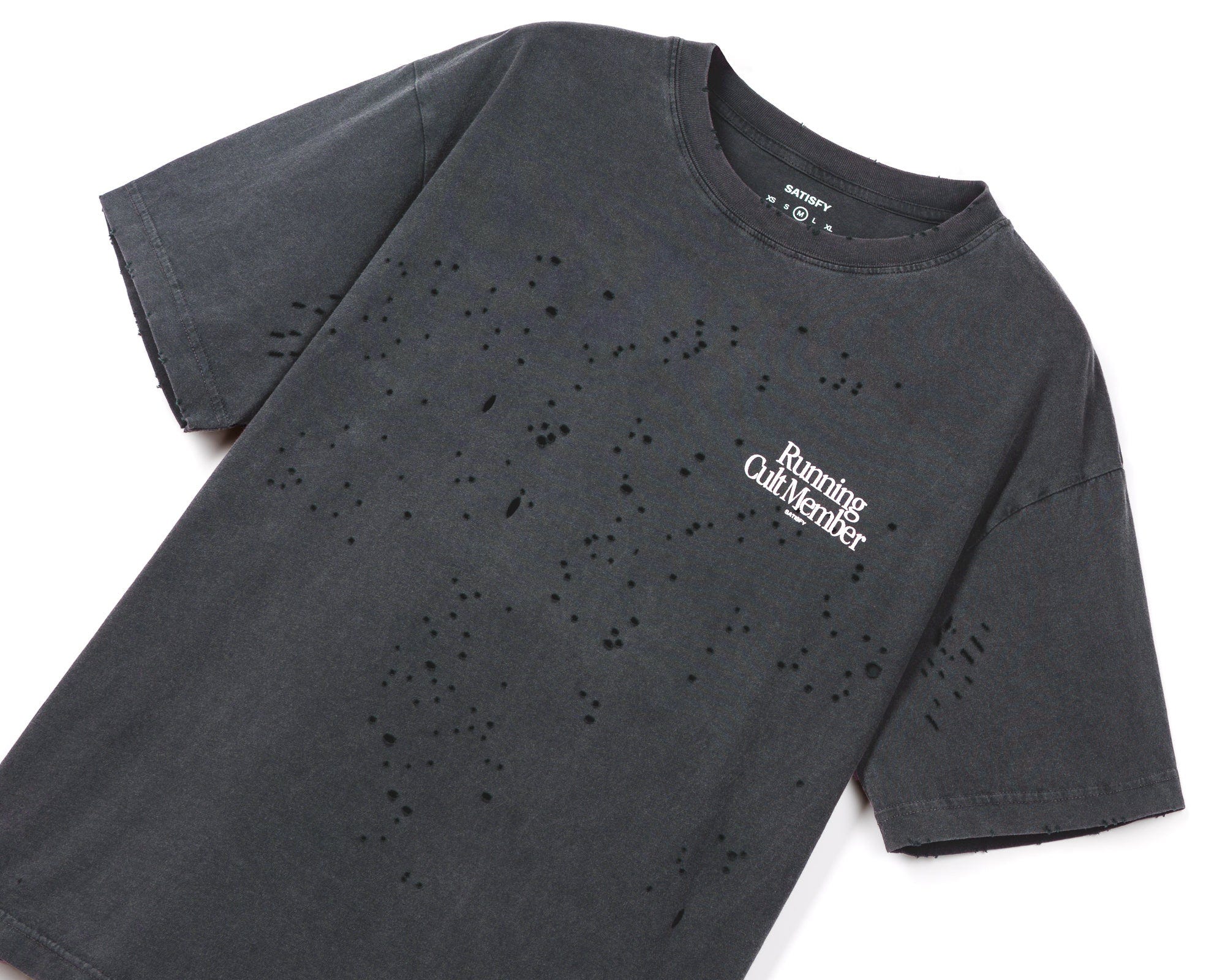
The aesthetic references were drawn from punk and skate culture rather than athletics. Vintage band tees, washed, lived-in fabrics, deliberately distressed surfaces that looked like they’d been worn for years before you bought them. The MothTech™ tee which is Satisfy’s most iconic product features ventilation holes that appeared as though moths had eaten through the fabric. Not quite the polished, engineered look of a performance product we were used to seeing at the time.
Gymshark did the same thing, but differently. It was a brand built in a garage for serious gym lifters, distributed almost entirely through bodybuilding expos and early YouTube fitness culture. The customer didn’t discover Gymshark through a paid ad in the beginning, they discovered it through a community they already belonged to, or aspired to belong to.

When your customer finds you rather than the other way around, the loyalty that follows is a different order of magnitude.
The brand is the badge
What these brands were really selling wasn’t a product but a way of belonging to a group with a shared set of values, aesthetics and reference points. The brand was the way you signalled those values to people who understood them. I have spoken countless times about the power of “if you know, you know” within brand culture - identifiers, design choices, product marks that allow you to be part of a community.
Tracksmith understood this from the beginning. Founded on what founder Matt Taylor called “the amateur spirit” of running, the person squeezing in a 6am run before work, training for a marathon around a full-time job, competing seriously without ever being paid to do so. Tracksmith was never targeted at elite athletes, but instead, dedicated ones. There’s a difference, and Tracksmith made it the entire message and identity.
That specificity, especially in the early days, isn’t a limitation but in fact a competitive advantage. The narrower the tribe, the deeper the loyalty runs.
The risk is that this architecture - this core reason for being - is difficult to scale without cracking. Once you start designing for people who didn’t find you and you go looking for them instead, you change the fundamental nature of what the brand is.
2. The Growth Trap
Money and the tension
At some point, the numbers for these niche brands get interesting enough that the brand moves from being a brand to a business.
This is followed by rounds of external investment and professional hires are often brought in to build the infrastructure the founders may have never thought were needed. There are suddenly revenue targets that begin to replace instinct as the primary decision-making tool. This isn’t a criticism but simply what growth looks like.
But here’s where the tension can start and mount. The investors who fund your next phase don’t want a brand that remains small and rooted to their niche values, they want results.
Outside money buys you infrastructure, distribution, headcount and reach. What it doesn’t buy, and what it quietly puts at risk, is the very thing that made the brand worth investing in; the specificity, point of view, cultural credibility that no amount of money can manufacture from scratch.
The professional hire problem
One of the subtler signals that a brand is entering its growth phase is the calibre of the operational hires it starts making.
Just this year, Tracksmith, who I would still consider a niche brand, appointed Jared Carver as CEO, a hire who spent fifteen years at Converse, including two as CEO. A seasoned operator from within the Nike ecosystem, now running an independent brand that defined itself partly in opposition to that world.
Each hire also brings a set of instincts shaped by larger, more commercially-driven organisations. And over time, those instincts shape decisions. The question isn’t whether the hire is good, but instead whether the brand’s founding DNA is strong enough to absorb the influence without diluting the brand.
The DTC ceiling
Most cult brands in sportswear were built on direct-to-consumer foundations. These are often both a commercial model decision and an identity statement. Selling directly meant controlling the experience, the price, and the narrative. Selling through wholesale meant sharing all three.
Gymshark built 96% of its revenue through owned channels at peak. That DTC dominance was central to the brand’s identity, and its margins. I must admit, I am equally surprised and impressed with Gymshark’s ability to grow solely relying on DTC. However, even Gymshark, in order to gain increasing presence across the US (their biggest market) have turned to wholesale, exclusively partnering with Dicks Sporting Goods across the region.
But DTC has a ceiling. Customer acquisition costs rise as the addressable audience shrinks. The economics that work at £10 million become challenging at £100 million. And so the brand that once refused to consider wholesale starts opening conversations with the very retailers it spent years bypassing.
Tracksmith and Satisfy quietly shifted in this direction too, embracing wholesale through run specialty shops across the US after years of DTC purism. In my opinion, it’s often the right commercial decision. You only have to look at Nike’s failed attempt of DTC focus to see that wholesale accounts offer so much more than just revenue, they offer credibility, reach and awareness.
3. Three Paths a Trend Brand Can Take
Stay small on purpose
The first option is to resist scale deliberately. Build scarcity into the model, hold the distribution tight, and accept that the revenue ceiling is part of the strategy rather than a problem to solve. Not every founder sets out with the intention of building a £100m, let alone a £1bn brand, and that is absolutely fine.
Tracksmith has navigated this better than most for a long time. Collegiate New England aesthetic, premium price points, selective stockists, a refusal to chase the mass market. The brand grew steadily rather than explosively. And the customer who bought in years ago still recognises what they bought into.

The founder’s transition to Chief Creative Officer while bringing in an experienced external CEO is the most interesting move here. It’s an attempt to professionalise the business without surrendering the creative soul. Matt Taylor keeps the brand and the new CEO runs the company.
Staying niche isn’t the same as staying still. The brands that do this well are the ones that keep moving. This means new product, new ideas, new cultural relevance, just within carefully maintained boundaries.
Collaborate your way up
The second option is to use the cultural capital you’ve built to access scale through partnership, without carrying the full operational weight of mass distribution yourself.
I have spoken previously about the On and Loewe collaboration, and although On is no longer a niche brand, I think this collaboration is relevant in terms of maintaining cultural credibility as you scale.
On didn’t need Loewe’s distribution but they needed cultural permission to exist in a space their performance credentials alone couldn’t open. Loewe, one of the most critically respected luxury houses in Europe, gave On exactly that. For Loewe, the partnership signalled an appetite for cultural relevance beyond the traditional luxury customer. Two brands, both reaching into territory that felt slightly beyond their own means. It almost certainly didn’t move the needle for On or Loewe’s revenue in any meaningful way, but that was never the point. In a category increasingly crowded with technically credible alternatives, it repositioned On as a brand with genuine cultural taste. Something a performance story alone can never quite do.

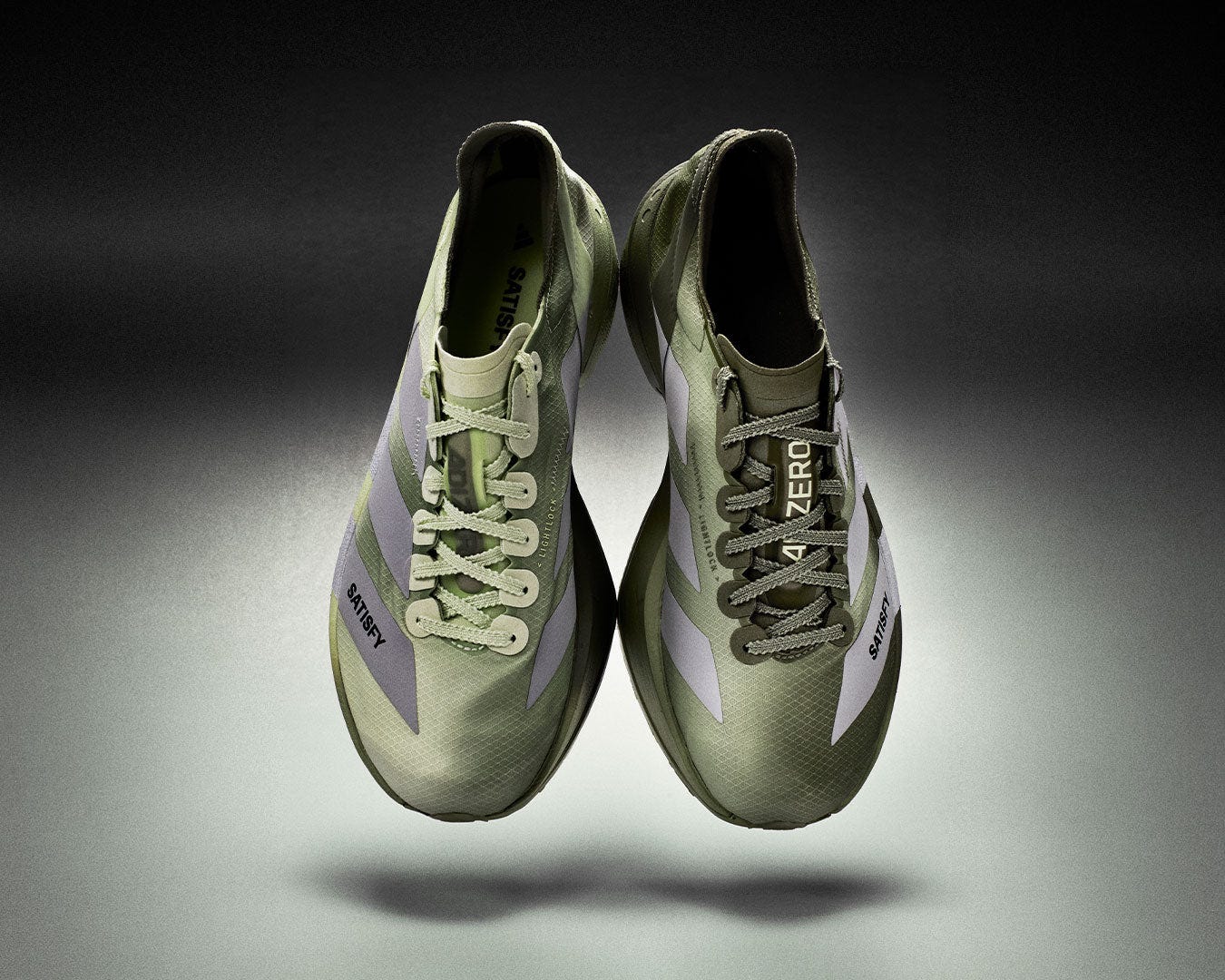
Moving onto the much maligned, much talked about (don’t worry, I wont be sharing my opinion on it) collaboration between Satisfy and adidas.
Although the response to the event (which I linked to a write-up from Grace Cook earlier) was largely negative throughout the running community, the partnership between the two brands is very relevant.

For Satisfy, the adidas partnership offers things that no amount of organic growth could deliver at the same speed. It gives Satisfy access to adidas’s global manufacturing network, a reach they could only dream of, and a distribution infrastructure that can put product in front of millions of people. For a brand with commercial aspirations, these are not small things.
The question over time is whether Satisfy shapes the collaboration or gets absorbed by it. The first instalment was a rework of the Adizero Adios Pro 4, not that inspiring, but I hope to see some apparel drop in the coming months, and then I can share my honest take on the partnership
4. When the Original Customer Leaves
The generational problem
Here’s the part that rarely gets talked about when scaling a business, the problem when the original customer packs up and leaves.
The people who found Gymshark in 2013 are now in their early thirties. Their relationship with training has changed. Their aesthetic references have shifted and the gym culture they were part of when they first bought a Gymshark hoodie looks different to the gym culture that exists today. Simply put, they have grown up. That’s not Gymshark’s fault, it’s simply just time, which unfortunately, catches up with us all.
I can’t think of many clothing related brands that capture you when you’re a teenager that you wear into your 30’s and 40’s.
But every brand that builds on a cultural moment has to accept the fact that moments move. The original audience doesn’t wait for you; they evolve, their tastes evolve, and the brand that once felt like they belonged to, no longer feels like that.
The authenticity paradox
The Satisfy customer who bought into the brand early did so partly because of what the brand wasn’t. It wasn’t Nike, adidas, asics or another established brand. It wasn’t mainstream, and it was an aesthetic and positioning never seen before in running.
Now Satisfy has nearly half a million Instagram followers and is stocked at Mr Porter, End. and SSENSE among countless others. The brand had a recent injection of cash and its partnerships with adidas, Oakley, and Our Legacy are signifiers it wants to scale across mainstream culture.
None of that is bad, and in fact, it’s evidence the brand built something real, but it fundamentally changes the nature of what you’re buying when you buy it. The early customer bought into a secret but the new customer is now buying into a fully established brand.
In my opinion, Satisfy will struggle to hold onto its authenticity and it’s roots (which, according to founder Brice Partouche, was largely shaped by punk music and skate culture) as they scale. My guess is that product will become more heavily branded and either prices will come down or we will start to see more entry level products which are more accessible to the masses. I may be wrong, but it’ll be interesting to see it unfold.
5. The Copycat Signal
When the big guys start watching
There is a specific moment that tells you a trend brand has crossed over into genuine cultural territory. It’s not the first major press feature or the wholesale account at a premium retailer, it’s when Nike copies your product.
Earlier this year, Satisfy publicly called out Nike for releasing a running top that closely mirrored their MothTech™ aesthetic. They described themselves as “surprised” to see a product that “closely mirrors our distinctive design.”
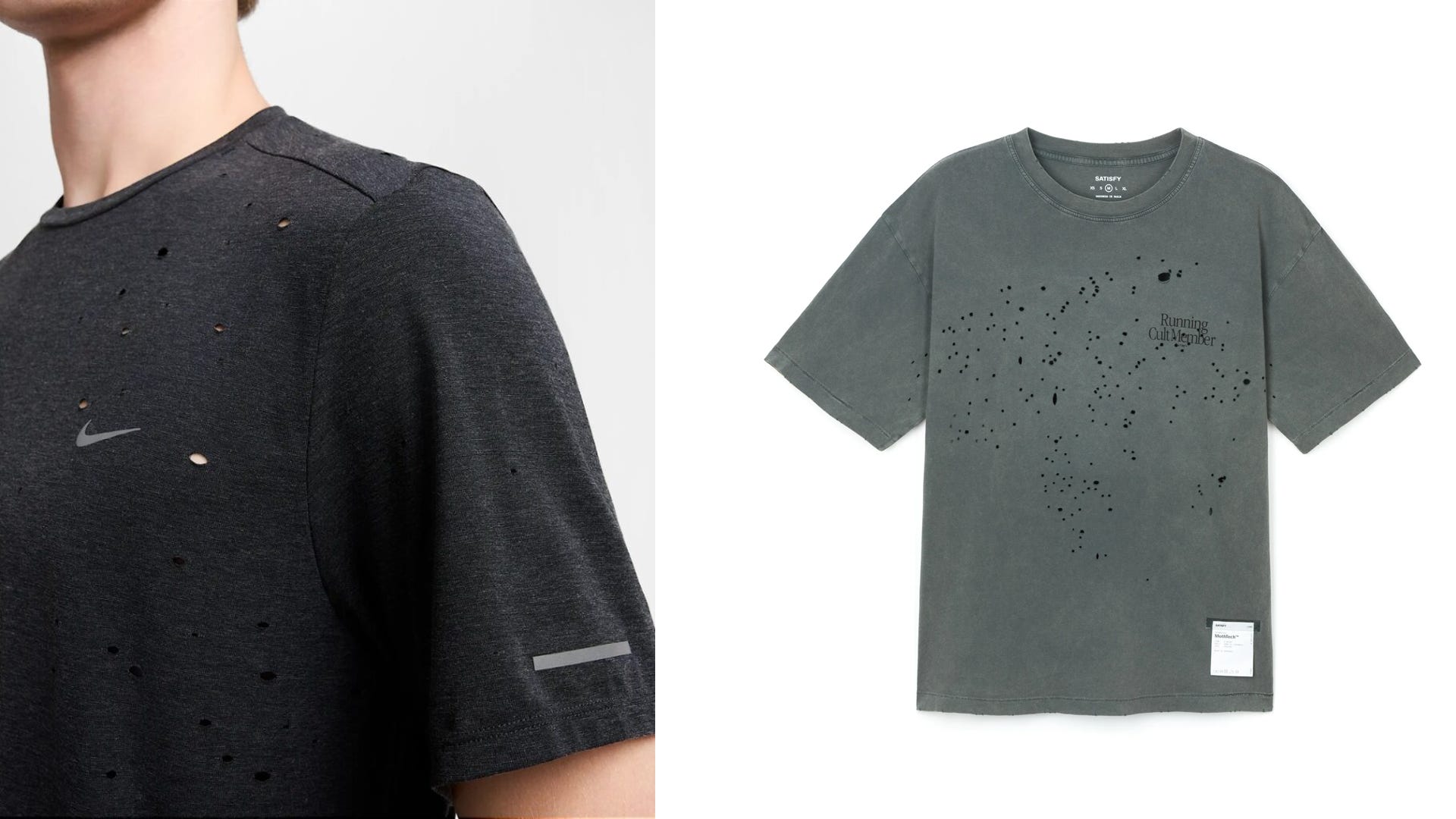
On one level, it may be seen as an issue that one of the biggest brands in the world is stealing your design identity. On another level, it’s a proof of concept. Nike does not replicate products from brands that haven’t earned it and being imitated by the largest sportswear company in the world is confirmation that you are culturally relevant, and designing products that are genuinely sought after.
When the aesthetic becomes a genre
The running market right now is full of brands working from the same set of references. This includes muted palettes, split shorts, ventilated holes, technical fabrics in considered silhouettes. There is an active rejection of the loud, logo-heavy aesthetic of the previous generation of running brands. But when it comes to Satisfy, what started as a specific point of view has become the default aesthetic for an entire emerging category.
In fact, not one to shy away from calling brands out, a few months back Brice Partouche (Satisfy founder) took to Instagram to call out another emerging brand -Currently Running - labelling them as “parasites” for essentially copying the design of their Space-O running shorts.
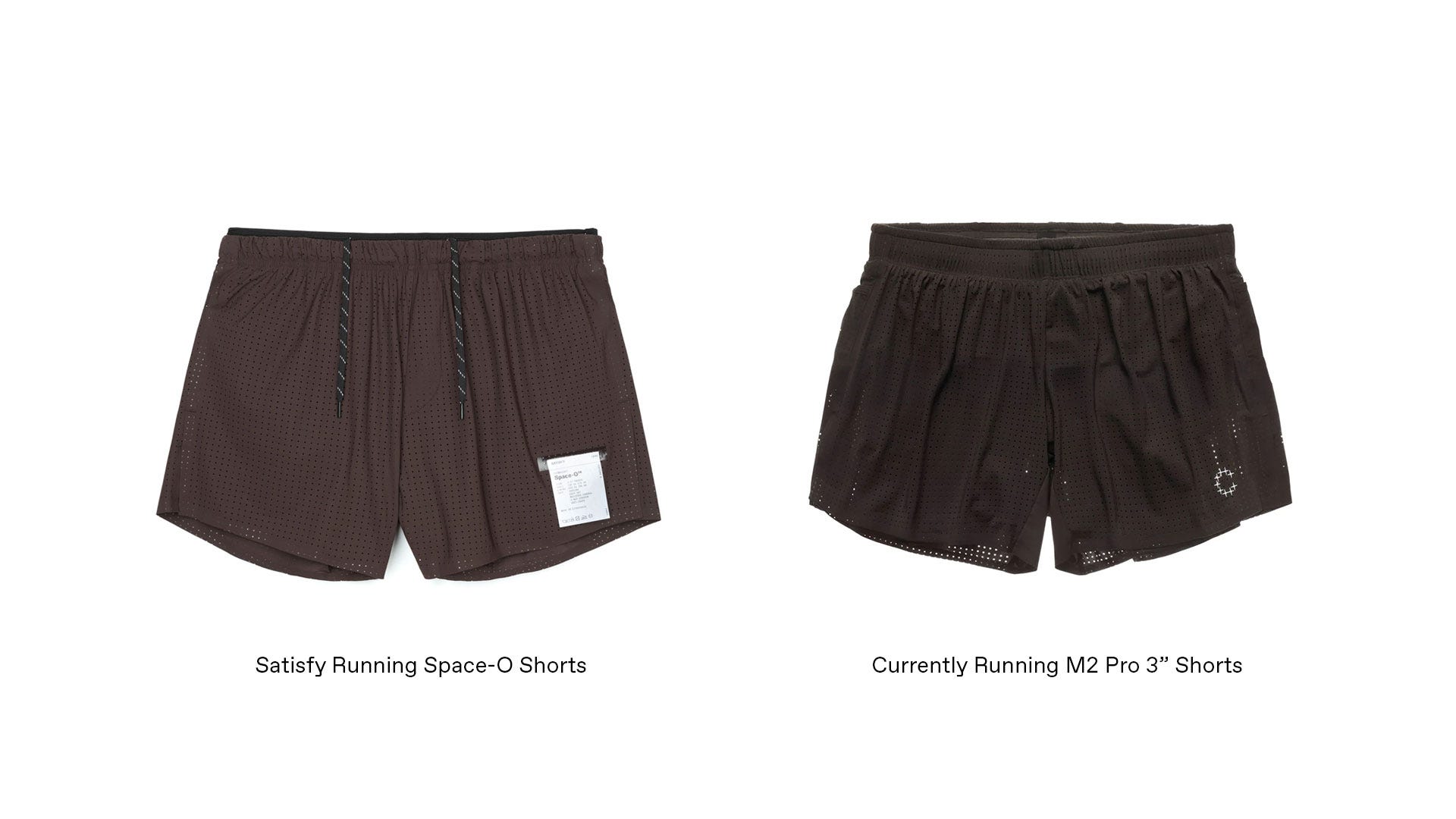
This is not Satisfy’s fault, and in fact, to shape a category like this is very noteworthy. But, as Satisfy have now found out, cultural influence rarely stays contained. It also does create a specific problem for the brand that originated the language. When the aesthetic becomes a genre, the original is harder to distinguish from the imitations. Brands like Miler Running, Currently and Optimistic Runners are just a few of the brands that have heavily borrowed from Satisfy’s aesthetic. And the customer who was attracted to the original for its specificity now has a dozen alternatives that look approximately the same.
6. What Actually Survives
Aesthetics get copied. Technology doesn’t.
When we analyse brands that build genuine longevity, we notice that whilst the aesthetic is important, at the forefront of every successful sportswear brand is product and innovation. Nike built its foundation on innovation, and Elliott Hill last year said that Nike’s recent troubles are partly due to the brand’s neglect for their “performance-first DNA”.
Community can be replicated with enough budget. Aesthetics get copied, as we’ve seen across the sportswear industry on countless occasions. There is a sea of sameness and although some copy-cat brands make it big, the majority fail. What’s genuinely difficult to replicate is a technical story that is owned, specific and continuously evolved.
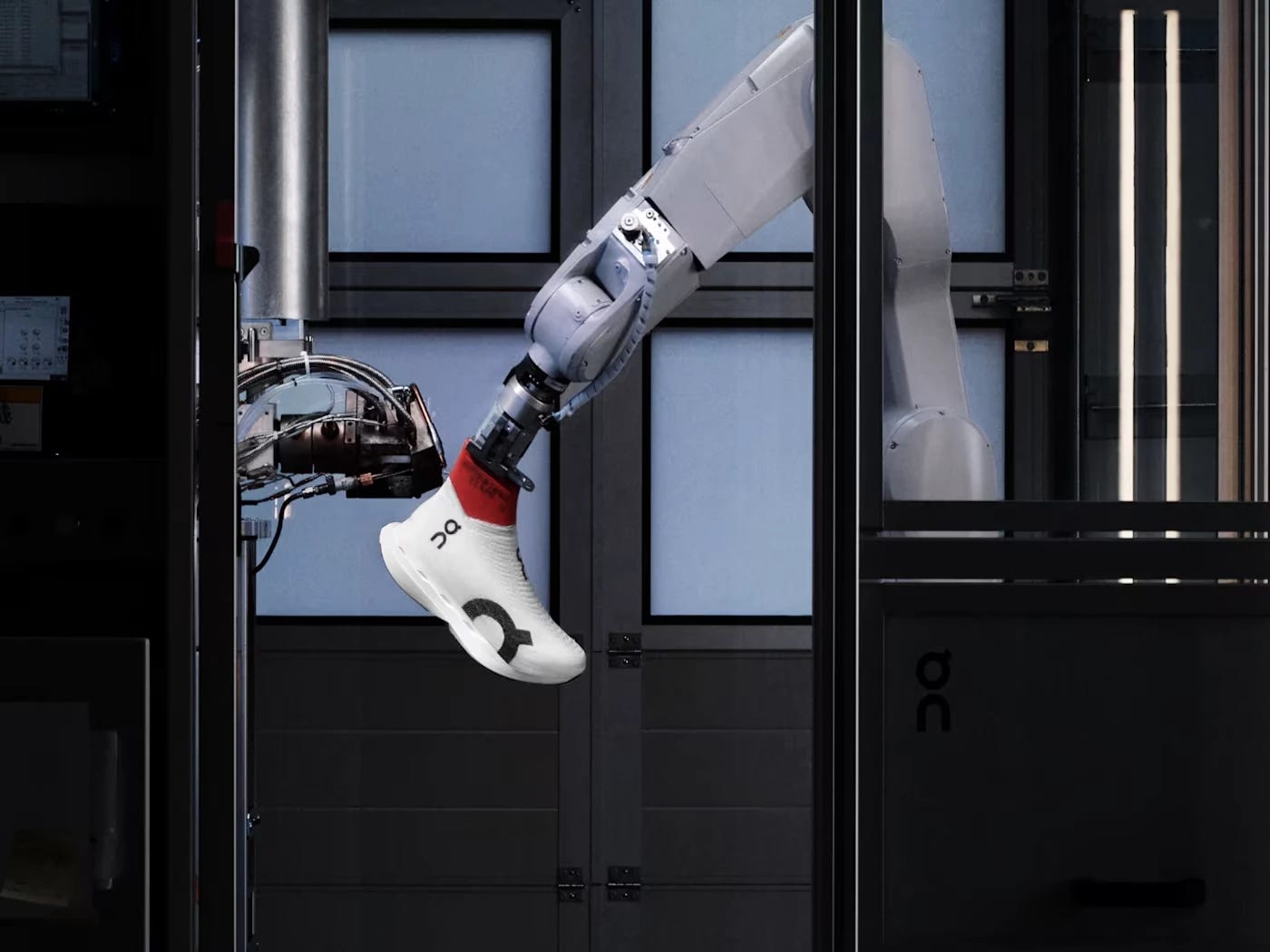
On Running is the clearest proof of this in the current market. CloudTec, the rubber pod sole system that gave On its founding identity, was always going to get copied. And it has been, in various forms, by various competitors. But On didn’t stop there, they kept building, kept innovating. The LightSpray, Cyclon, SURREAL superfoam, the list goes on. It’s a brand that truly puts innovation at its heart, and its growth (as other big players stagnate), just reaffirm the importance of constant innovation.
The non-negotiables
I don’t believe a brand has to stay small to stay real. Some of the most culturally credible brands in sportswear are not small. They’ve just been precise about what they were willing to trade as they grew.
Arc’teryx is a good example of this outside of sportswear. A brand founded by climbers, not designers. People who used the product in conditions where it actually mattered. That founding obsession with function has never left, and it shows in how they approach product development. Every season there is something being worked on that most consumers will never notice or appreciate. Seam tape reduced to save grams, panel angles reconfigured for better movement, fabric constructions pushed until they fail. They approach the business like an engineering culture that happens to make clothing.
The Alpha SV is the proof. Launched in 1998 and still the flagship today. In the twenty-seven years since, it has been refined continuously, over 300 grams lighter, Gore-Tex Pro upgraded, face fabric moved to recycled construction, PFAS removed in 2025. Each update small on its own. Together, they tell the story of a brand that has never once decided the product was done. If you want to watch an awesome video on the building of the Alpha SV, check out the video below;
That’s the difference between a brand that innovates and a brand that launched something good. One keeps building whilst the other protects what it has.
The brands that make it through are the ones that identified their non-negotiables early, and held onto them when the commercial pressure to compromise arrived. The pressure to grow will always arise, but staying true to your core commitment as a company, whether that be a unwavering design language (Rimowa), a pure focus on community (Gymshark), or continuous innovation (On) - these are the brands that survive as they grow.
I don’t believe there’s a one-fits-all formula for staying culturally relevant as you scale. But I do believe the brands that manage it are the ones who knew exactly what they were selling before the money arrived. Not the product but instead the world the product belonged to. Hold onto that, and you have something worth protecting.
Final Thread
I don’t believe the brands that survive scale are the ones with the best strategy slides or the most experienced hires. I think they’re the ones whose founders were obsessed with something specific, and were honest enough with themselves about what that thing was before the financial pressure to grow arose.
As I mentioned earlier, I spent ten days in the Maldives recently, mostly disconnected from the industry. Just waves, water and a lot of time to think. A related thought that crossed my mind was how some surfers look completely at home in the water, even in conditions that would unsettle most people. The reason for this is because they have never tried to surf like someone else, they’ve simply just surfed more.
The brands that last are usually the same. Not the ones that studied what worked elsewhere or by a competitor brand and applied it themself. It’s the ones that kept doing the thing they were built for, repeatedly, until nobody could do it quite the same way.
The challenge now, for all of these growing nice brands, is whether the infrastructure they’ve built serves that original thing or slowly replaces it.
Thanks, as always, for reading Friday Thread. If you enjoyed this article, please share and subscribe, it really does make a huge difference.
Such a good read Seb, top work
really good post i enjoyed reading it, very measured and thoughtful.
the hard truth for satisfy is as you say in point 2....once you take VC cash they want you to spend it as quickly as possible on rapid growth .... so they can get an exit and return on investment.
its really hard to think of brands that grow without losing their "soul". nudie jeans springs to mind, brompton. patagonia obviously
they all have a very strong core product with a focus on quality and repairability (worn wear, repair shops etc). that longevity of use keeps them relevant imo